리프팅 시술, 왜 금방 돌아올까? 20년 이상 경력의 전문의·의학박사가 말하는 유지력의 차이
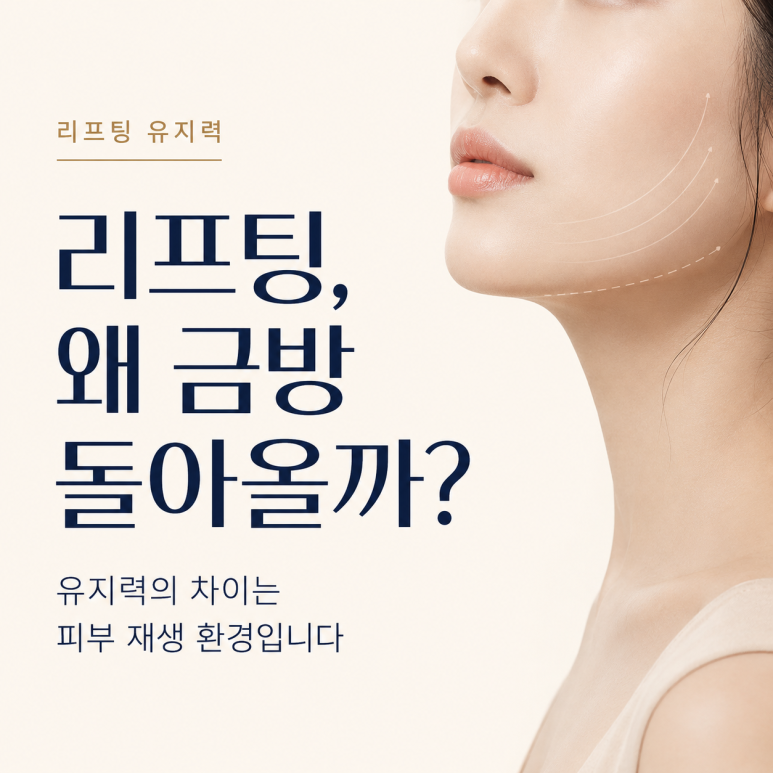
리프팅 시술,
왜 금방 원래대로 돌아올까요?
의학박사가 설명하는 ‘유지력’의 차이
“같은 장비로 리프팅을 받았는데,
왜 누구는 오래가고
누구는 금방 돌아오는 것처럼 느껴질까요?”
리프팅 시술을 받은 직후에는 얼굴선이 정리되고 피부가 한층 탄탄해진 것처럼 느껴졌는데,
시간이 지나면서 생각보다 빨리 원래대로 돌아온 것 같다고 말씀하시는 분들이 있습니다.
같은 장비, 비슷한 강도, 비슷한 시술을 받았는데도
어떤 분은 유지감이 오래가는 것 같고,
어떤 분은 금방 풀린 것처럼 느끼는 이유는 무엇일까요.
결론부터 말씀드리면,
리프팅 유지기간은 단순히 장비의 종류나
시술 강도만으로 결정되지 않습니다.
중요한 것은 시술 후 피부가 얼마나 잘 회복하고,
콜라겐을 새롭게 만들어낼 수 있는 상태인가입니다.
안녕하세요.
청담나의원 송효영 대표원장입니다.
저는 전문의이자 의학박사로서,
리프팅 시술을 단순히 피부를 당기는 과정만이 아니라
피부가 스스로 재생 반응을
일으키도록 돕는 과정까지라고 보고 있습니다.
리프팅을 받았는데 유지기간이
기대보다 짧게 느껴졌다면,
단순히 “장비가 약했다”거나
“시술이 잘못됐다”고만 판단하기보다는,
피부가 시술 자극(초음파 에너지)에 충분히 반응하여 콜라겐을 재생하고
끌어올리고 당기는 힘을 만들어 낼 회복력이 있는
상태인지를 함께 살펴볼 필요가 있습니다.
리프팅의 핵심은
‘당기는 것’ 이상의 ‘재형성’입니다
많은 분들이 리프팅을 피부를 위로
끌어올리는 시술로 생각합니다.
물론 시술 직후 느껴지는 타이트닝이나
얼굴선 정리도 중요한 변화입니다.
하지만 울쎄라, 써마지와 같은
에너지 기반 리프팅 시술은
단순히 피부를 당기는 데서 끝나는 시술이 아닙니다.
피부 조직에 적절한 자극을 주고,
그 자극 이후의 회복 과정에서
콜라겐 재형성과 탄력 개선을
유도하는 방식에 가깝습니다.
쉽게 말해 시술은 피부에
“재생 신호”를 주는 과정입니다.
그리고 실제로 콜라겐을 만들고
회복 반응을 일으키는 것은
환자 본인의 피부와 몸입니다.
그래서 같은 장비, 같은 에너지,
같은 실을 사용하더라도 결과와 유지감은
사람마다 다르게 나타날 수 있습니다.
리프팅 유지력의 차이는 시술 자체뿐 아니라,
피부가 그 자극에 얼마나
잘 반응할 수 있는지에 따라 달라집니다.
리프팅 효과가 짧게 느껴지는 이유
리프팅 결과는 시술 당일에만 결정되지 않습니다.
시술 후 수주에서 수개월에 걸쳐 피부 속에서는 콜라겐 재형성, 염증 조절, 조직 회복 과정이 이어집니다.
이 과정이 충분히 일어나려면 피부와 몸의 상태가 함께 준비되어 있어야 합니다.
콜라겐을 만들 수 있는 피부의 영양 재료가 부족하거나,
호르몬 변화로 인해 피부 탄력이 떨어져 있거나,
만성 염증과 산화 스트레스가 높은 상태라면
시술 후 기대했던 만큼의 재생 반응이
충분히 나타나지 않을 수 있습니다.
이때 환자분들은
“시술 효과가 금방 사라졌다”고 느끼게 됩니다.
하지만
실제로는 시술자극이 사라졌다기보다,
피부가 자극을 받은 뒤 회복하고
재생할 수 있는 환경이 부족했을 가능성도 있습니다.
"리프팅은 단순히 피부를 당기는 시술이 아니라,
피부가 다시 탄력을 회복할 수 있도록
자극을 주는 과정입니다."
첫 번째, 콜라겐 합성에 필요한 영양 상태
콜라겐은 피부 탄력을 지탱하는
중요한 구조 단백질입니다.
피부가 탄탄하게 유지되기 위해서는
콜라겐이 충분히 형성되고,
기존 콜라겐이 건강하게 유지되어야 합니다.
콜라겐 합성에는 단백질, 아미노산, 비타민 C 등
여러 영양 요소가 관여합니다.
평소 식사가 불규칙하거나 단백질 섭취가 부족한 경우,
무리한 다이어트로 영양 상태가 떨어진 경우에는
시술 후 피부가 기대만큼의 재생 반응을
보이지 못할 수 있습니다.
리프팅은 피부에 자극을 주는 시술입니다.
그런데 그 자극을 회복과 재생으로 연결하려면 피부가 사용할 수 있는 재료가 필요합니다.
즉, 오래가는 리프팅을 위해서는
어떤 장비를 사용할지뿐 아니라,
내 피부가 콜라겐을 만들 수 있는 상태인지도
함께 확인해야 합니다.
두 번째, 여성호르몬 변화와 피부 탄력 저하
40대 이후부터는
“예전에는 시술 효과가 괜찮았는데
요즘은 유지가 짧아진 것 같다”
고 느끼는 분들이 많습니다.
이 시기에는 여성호르몬 변화가 피부 두께,
수분 유지력, 콜라겐 밀도, 탄력감에
영향을 줄 수 있습니다.
특히 에스트로겐 변화는 피부 탄력과 보습,
콜라겐 유지와 관련이 있는 것으로 알려져 있습니다.
그래서 호르몬 변화가
큰 시기에는 같은 리프팅을 받아도
이전보다 효과가 짧게 느껴지거나,
회복 속도가 늦게 느껴질 수 있습니다.
이런 경우 무조건 강한 시술을
반복하는 것만이 답은 아닙니다.
피부 탄력이 왜 떨어졌는지,
피부가 회복할 수 있는 상태인지,
생활습관이나 수면, 스트레스,
영양 상태가 함께 영향을 주고 있지는 않은지
살펴보는 것이 중요합니다.
피부는 얼굴에만 따로 존재하는 조직이 아닙니다.
피부는 전신 건강 상태를 반영하는 기관입니다.
세 번째, 만성 염증과 산화 스트레스
몸속 염증 상태가 높거나 산화 스트레스가 큰 경우에도
피부 회복 과정이 원활하지 않을 수 있습니다.
시술 후 피부에는 일시적인 회복 과정이 필요합니다.
그런데 수면 부족, 잦은 음주, 흡연, 과도한 스트레스,
불규칙한 식습관이 반복되면
피부 재생 환경이 떨어질 수 있습니다.
이런 상태에서는 리프팅을 반복해도
기대한 만큼 오래 유지되지 않는다고 느낄 수 있습니다.
특히 피로감이 심하고 회복이 느린 분들,
피부 장벽이 약하고 염증 반응이 잦은 분들,
다이어트와 폭식을 반복하는 분들은
리프팅 전후 관리에서
피부 자체뿐 아니라 전신 컨디션을
함께 보는 것이 필요합니다.
오래가는 리프팅은 피부 상태와
몸 상태를 함께 봐야 합니다
리프팅은 장비만으로 완성되는 시술이 아닙니다.
시술자의 판단, 피부 상태, 콜라겐 재형성 능력,
생활습관, 전신 컨디션이 함께 맞아야 보다
만족스러운 결과를 기대할 수 있습니다.
청담나의원의 리프팅 접근 방식
청담나의원은 리프팅을 단순히
얼굴선을 당기는 시술로만 보지 않습니다.
피부가 자극을 받은 뒤 잘 회복하고 재생할 수 있도록,
시술 전후의 상태를 함께
살피는 것을 중요하게 생각합니다.
먼저 피부 두께와 탄력, 처짐의 방향,
얼굴형, 지방 분포를 종합적으로 확인합니다.
같은 리프팅이라도 얼굴형과 피부 상태에 따라
필요한 에너지 깊이와 시술 방향은
달라질 수 있기 때문입니다.
또한 리프팅 유지기간이 짧게 느껴지는 분들은
피부 자체의 문제만이 아니라
영양, 수면, 스트레스, 호르몬 변화,
대사 상태가 함께 영향을 주는 경우가 있습니다.
필요한 경우 이러한 요소를 함께 확인하여
피부가 재생 반응을 잘 일으킬 수 있는
환경인지 살펴봅니다.
개인의 건강 상태와 복용 약물,
기저질환 여부를 확인한 뒤
필요한 범위 안에서 진행합니다.
복용 중인 약물이나 건강 상태에 따라
시술 타이밍을 조정해야 하는 경우도 있습니다.
무조건 많이 하는 것보다,
제대로 반응할 수 있게 하는 것이 중요합니다
저는 환자분들께 무작정 리프팅
시술 횟수를 늘리라고 권하지 않습니다.
피부가 충분히 반응하기 어려운 상태라면,
같은 시술을 반복해도 만족도가 낮을 수 있습니다.
이런 경우에는 먼저 피부와 몸의 회복 환경을 정리한 뒤
시술 계획을 세우는 것이 더 합리적일 수 있습니다.
오래가는 리프팅을 원하신다면
“어떤 장비가 가장 강한가”만 볼 것이 아니라,
“내 피부가 그 자극에 잘 반응할 수 있는 상태인가”를
먼저 확인해보는 것이 좋습니다.
리프팅의 유지력은 시술 강도만의 문제가 아니라,
피부 재생 환경의 문제이기도 합니다.
"리프팅을 오래 유지하고 싶다면,
강한 시술을 반복하기 전에
내 피부가 회복할 준비가 되어 있는지
먼저 확인해야 합니다."
리프팅 유지력에 대해 자주 묻는 질문
Q. 영양 상태가 좋지 않으면
리프팅 효과가 아예 없나요?
효과가 전혀 없다고 말할 수는 없습니다.
다만 콜라겐 합성과 조직 회복에 필요한
영양 상태가 부족한 경우,
기대했던 유지기간보다 짧게 느껴질 수 있습니다.
비싼 시술을 자주 반복하는 것보다,
한 번의 시술을 받더라도
피부가 잘 반응할 수 있는 상태에서
진행하는 것이 더 합리적일 수 있습니다.
Q. 리프팅 후 바로 효과가 보이지 않으면
실패한 건가요?
그렇지 않습니다.
에너지 기반 리프팅의 경우 시술 직후의
타이트닝도 일부 느낄 수 있지만,
콜라겐 재형성은 보통 수주에서
수개월에 걸쳐 진행됩니다.
따라서 시술 직후의 느낌만으로
결과를 판단하기보다는,
일정 기간 동안 피부가 어떻게 변화하는지
확인하는 것이 중요합니다.
다만 개인의 피부 상태, 시술 종류,
에너지 강도, 생활습관에 따라
결과는 다르게 나타날 수 있습니다.
Q. 리프팅 전에 어떤 부분을
체크하면 좋나요?
최근 체중 변화, 수면 상태, 단백질 섭취,
스트레스, 생리 주기 또는
폐경 전후 변화, 기존 시술 이력, 복용 중인 약물 등을
함께 확인하는 것이 좋습니다.
특히 반복적으로 리프팅 유지기간이
짧게 느껴졌던 분이라면,
단순히 장비를 바꾸기보다
피부 재생 환경을 함께 살피는 것이
도움이 될 수 있습니다.
Q. 리프팅 유지력을 위해
평소 관리할 수 있는 부분이 있나요?
충분한 단백질 섭취,
비타민 C가 포함된 균형 잡힌 식사, 수면 관리,
자외선 차단, 금연, 과도한 음주 줄이기 등이
기본입니다.
특정 영양제나 수액은 개인의 건강 상태에 따라
적합 여부가 달라질 수 있으므로,
의료진과 상담 후 결정하는 것이 안전합니다.
리프팅은 시술과 재생 환경이 함께 만드는 결과입니다
리프팅 효과가 빨리 사라지는 것처럼 느껴진다면,
단순히 장비가 약했기 때문이라고만
생각할 필요는 없습니다.
피부가 얼마나 잘 회복하고,
콜라겐을 새롭게 만들 수 있는 상태인지가
유지기간에 영향을 줄 수 있습니다.
청담나의원은 리프팅을 단순한 미용 시술이 아니라,
피부와 몸의 상태를 함께 고려해야 하는
재생 과정으로 바라봅니다.
오래가는 리프팅을 원하신다면,
지금 내 피부가 어떤 상태인지부터
정확히 확인해보시기 바랍니다.
Lifting Procedures, Why Do They Wear Off So Quickly? A Specialist and Medical Doctor with Over 20 Years of Experience Explains the Difference in Longevity
Lifting procedures,
why do they go back to the original state so quickly?
A Medical Doctor explains the difference in 'longevity.'
“We received lifting with the same device,
but why does it last long for some people,
while for others, it feels like it returns to normal quickly?”
Immediately after receiving a lifting procedure, the facial line feels refined and the skin feels a tier firmer,
but as time passes, there are those who say it seems to have returned to its original state faster than expected.
Even though they received the same device, similar intensity, and similar procedures,
why is it that some people feel the maintenance lasts long,
while others feel as if it loosened up quickly?
To give you the conclusion first,
the maintenance period of lifting is not determined simply by the type of device or
the intensity of the procedure alone.
What is important is how well the skin recovers after the procedure and
whether it is in a state capable of newly creating collagen.
Hello.
I am Song Hyo-young, the Chief Director of Cheongdam Na Clinic.
As a specialist and a Medical Doctor (Ph.D. in Medicine),
I view a lifting procedure not simply as a process of pulling the skin,
but as a process that extends to helping the skin elicit a regeneration response
by itself.
If you received lifting but felt the maintenance period was
shorter than expected,
rather than simply judging that “the device was weak” or
“the procedure was done wrong,”
it is necessary to look together at whether the skin is in a state
of having the resilience to sufficiently react to the procedure stimulation (ultrasound energy), regenerate collagen,
and create the power to pull up and tighten.
The Core of Lifting is 'Remodeling' Beyond 'Pulling'
Many people think of lifting as a procedure
that pulls the skin upward.
Of course, the tightening felt immediately after the procedure or
the refinement of the facial line are also important changes.
However, energy-based lifting procedures such as Ultherapy and Thermage
are not procedures that end simply with pulling the skin.
It is closer to a method that gives appropriate stimulation to the skin tissue
and induces collagen remodeling and elasticity improvement
in the recovery process after that stimulation.
To put it easily, a procedure is a process of giving a
“regeneration signal” to the skin.
And what actually makes the collagen and
causes the recovery reaction
is the patient's own skin and body.
Therefore, even if the same device, the same energy,
and the same threads are used, the result and the feeling of maintenance
can appear differently for each person.
The difference in lifting longevity depends not only on the procedure itself,
but on how well the skin
can react to that stimulation.
Reasons Why the Lifting Effect is Perceived as Short
Lifting results are not determined on the day of the procedure alone.
Over several weeks to several months after the procedure, the processes of collagen remodeling, inflammation regulation, and tissue recovery continue inside the skin.
For this process to occur sufficiently, the condition of the skin and body must be prepared together.
If the skin's nutritional materials capable of making collagen are insufficient,
if skin elasticity is dropped due to hormonal changes,
or if chronic inflammation and oxidative stress are high,
the expected regeneration reaction after the procedure
may not fully appear.
At this time, patients
come to feel that “the procedure effect disappeared quickly.”
However,
in reality, rather than the procedure stimulation disappearing,
it is also possible that the environment for the skin to recover and
regenerate after receiving the stimulation was lacking.
Lifting is not simply a procedure that pulls the skin,
but a process of giving stimulation so that
the skin can restore its elasticity again.
First, the nutritional status required for collagen synthesis
Collagen is an important structural protein
that supports skin elasticity.
For the skin to stay firm,
collagen must be formed sufficiently,
and existing collagen must be maintained healthily.
Various nutritional elements such as proteins, amino acids, and vitamin C
are involved in collagen synthesis.
If daily meals are irregular, if protein intake is insufficient,
or if nutritional status is dropped due to excessive dieting,
the skin may fail to show the expected regeneration reaction
after the procedure.
Lifting is a procedure that gives stimulation to the skin.
However, to connect that stimulation to recovery and regeneration, materials that the skin can use are needed.
In other words, for a long-lasting lifting,
you must check not only what device to use,
but also whether my skin is in a state capable of making collagen.
Second, female hormone changes and decreased skin elasticity
From the 40s onward,
there are many people who feel,
“In the past, the procedure effect was decent,
but these days the maintenance seems to have become short.”
During this period, female hormone changes can affect skin thickness,
moisture retention, collagen density, and the sensation of elasticity.
In particular, estrogen changes are known to be related to skin elasticity, moisturization,
and collagen maintenance.
Therefore, during a period of significant hormonal changes,
even if you receive the same lifting,
the effect may feel shorter than before,
or the recovery speed may feel slower.
In these cases, blindly repeating strong procedures
is not the only answer.
It is important to examine why skin elasticity dropped,
whether the skin is in a state capable of recovering,
and whether lifestyle habits, sleep, stress,
or nutritional status are exerting an influence together.
The skin is not a tissue that exists separately only on the face.
The skin is an organ that reflects the overall health status of the entire body.
Third, chronic inflammation and oxidative stress
Even when the inflammation status inside the body is high or oxidative stress is significant,
the skin recovery process may not flow smoothly.
After a procedure, a temporary recovery process is required for the skin.
However, if lack of sleep, frequent drinking, smoking, excessive stress,
and irregular eating habits are repeated,
the skin regeneration environment can drop.
In such a state, even if lifting is repeated,
you may feel that it does not maintain as long as expected.
In particular, for those whose fatigue is severe and recovery is slow,
those whose skin barrier is weak and inflammatory reactions are frequent,
and those who repeat dieting and binge eating,
it is necessary to look at the overall body condition as well as the skin itself
in the management before and after lifting.
For a Long-Lasting Lifting, the Skin Condition and Body Condition Must Be Looked at Together
Lifting is not a procedure completed by a device alone.
The practitioner's judgment, skin condition, collagen remodeling ability,
lifestyle habits, and overall body condition must match together to expect a more
satisfactory result.
Cheongdam Na Clinic's Lifting Approach Method
Cheongdam Na Clinic does not view lifting simply
as a procedure that pulls the facial line.
We consider it important to look at the condition before and after the procedure together
so that the skin can recover and regenerate well after receiving stimulation.
First, we comprehensively verify skin thickness, elasticity, the direction of sagging,
face shape, and fat distribution.
This is because even for the same lifting, the required energy depth and procedure direction
can vary depending on the face shape and skin condition.
In addition, for those who feel the lifting maintenance period is short,
there are cases where not only the problem of the skin itself
but also nutrition, sleep, stress, hormone changes,
and metabolic status exert an influence together.
If necessary, we verify these elements together to examine
whether it is an environment where the skin can elicit a regeneration response well.
After verifying an individual's health status, taken medications,
and the presence of underlying diseases, we proceed within the required range.
Depending on the medications being taken or the health status,
there are also cases where the procedure timing must be adjusted.
Rather Than Blindly Doing a Lot, It Is Important to Enable Proper Reactions
When it comes to Ultherapy procedures,
I do not recommend patients blindly increase the number of procedure sessions.
If the skin is in a state where it is difficult to react sufficiently,
satisfaction may be low even if the same procedure is repeated.
In such cases, it may be more reasonable to establish a procedure plan
after first sorting out the recovery environment of the skin and body.
If you want a long-lasting lifting,
instead of looking only at “which device is the strongest,”
it is good to first check “whether my skin is in a state capable of reacting well to that stimulation.”
The longevity of lifting is not a matter of procedure intensity alone,
but also a matter of the skin regeneration environment.
If you want to maintain lifting for a long time,
before repeating strong procedures,
you must first check whether your skin is ready to recover.
Frequently Asked Questions About Lifting Longevity
Q. If my nutritional status is not good, is there no lifting effect at all?
It cannot be said that there is no effect at all.
However, if the nutritional status required for collagen synthesis and tissue recovery is lacking,
it may be perceived as shorter than the expected maintenance period.
Rather than repeating expensive procedures frequently,
it can be more reasonable to proceed in a state where the skin can react well,
even if you receive a procedure just once.
Q. If the effect is not visible right after lifting, is it a failure?
That is not the case.
In the case of energy-based lifting, some tightening can be felt immediately after the procedure,
but collagen remodeling usually progresses over several weeks to
several months.
Therefore, rather than judging the result solely by the feeling right after the procedure,
it is important to check how the skin changes over a certain period of time.
However, the result can appear differently depending on an individual's skin condition, type of procedure,
energy intensity, and lifestyle habits.
Q. What parts are good to check before lifting?
It is good to check recent weight changes, sleep status, protein intake,
stress, menstrual cycle or pre-/post-menopausal changes, past procedure history, and currently taken medications
together.
In particular, if you are someone who repeatedly felt that the lifting maintenance period was short,
rather than simply changing the device,
examining the skin regeneration environment together can be helpful.
Q. Is there a part I can manage routinely for lifting longevity?
Sufficient protein intake,
a balanced diet including vitamin C, sleep management,
sun protection, quitting smoking, and reducing excessive drinking are the basics.
Since the appropriateness of specific nutritional supplements or IV fluids can vary depending on an individual's health status,
it is safe to decide after consulting with medical staff.
Lifting is a Result Created Together by the Procedure and the Regeneration Environment
If it feels like the lifting effect disappears quickly,
you do not need to think that it is simply because the device was weak.
How well the skin recovers and
whether it is in a state capable of newly creating collagen can affect the maintenance period.
Cheongdam Na Clinic views lifting not as a simple cosmetic procedure,
but as a regeneration process that must consider the condition of the skin and body together.
If you want a long-lasting lifting,
please accurately check what kind of state your skin is in starting from now.
#청담동덴서티 #청담동스킨부스터 #청담동필러 #청담동보톡스 #청담동울쎄라 #청담동리니어지 #청담동포텐자 #서울덴서티 #서울스킨부스터 #서울필러 #서울보톡스 #서울울쎄라 #서울리니어지 #서울포텐자
#CheongdamdongDensity #CheongdamdongSkinBooster #CheongdamdongFiller #CheongdamdongBotox #CheongdamdongUlthera #CheongdamdongLinearZ #CheongdamdongPotenza #SeoulDensity #SeoulSkinBooster #SeoulFiller #SeoulBotox #SeoulUlthera #SeoulLinearZ #SeoulPotenza